
Organize to Thrive
Productivity Coaching, Time Management Consulting and Leadership Coaching for business and nonprofits - get your most important work done. Collaborating with leaders and their teams to become more strategic, focused and productive. Leadership and Board Coaching, Strategic Planning Facilitation, Productivity Coaching and Time Management Consulting, Professional Speaker.
Productivity Coach, Productivity Consultant, Leadership Coach, Time Management Coach, Business Consulting, personal productivity, time management, nonprofit, board coach, collaboration, strategic planning, facilitation, change management, leading productive teams, project planning, board development, volunteer engagement, association management, workplace productivity, executive director.
-1
archive,category,category-organizing,category-4,wp-theme-bridge,bridge-core-3.3.4.8,qode-page-transition-enabled,ajax_fade,page_not_loaded,,qode_grid_1200,footer_responsive_adv,qode-theme-ver-30.8.8.8,qode-theme-bridge,wpb-js-composer js-comp-ver-8.7.3,vc_responsive

Organize to Thrive

While I don’t consider myself an ADHD coach, over the years in my work as a professional organizer, coach, and productivity trainer I’ve had a great deal of training and learned a lot about supporting clients who live with ADHD and other executive function challenges. Although I haven’t worked hands-on in clients’ physical spaces since before the pandemic — hard to believe that’s now six years ago — I spent two decades organizing homes and offices after launching my business in 2001. I added coaching to my practice in 2008 and began fully integrating organizing and coaching work in 2011.

Recently, a colleague invited me to present on organizing at the International ADHD Virtual Conference. Preparing for that session reminded me that many of the principles I’ve taught for years are especially helpful for people whose brains process decisions, structure, and follow-through differently.

Here are a few highlights — ideas that can help anyone create systems that make life easier.

  • When people think about getting organized, they often imagine labeled bins, color-coded planners, or picture-perfect spaces. But real organization — the kind that truly supports your life — isn’t about aesthetics. It’s about reducing friction.
  • Being organized is not a personality trait or a moral virtue. It’s a quality-of-life strategy. It reduces stress, saves time, and prevents unnecessary frustration so you can direct your energy toward what matters most. Small systems make a big difference. Something as simple as consistently putting your keys in the same place can eliminate daily stress. These practical habits reduce frition and create calm and reliability in otherwise busy lives.
  • When you make a decision to do something, pause and ask yourself “how am I going to remember to remember?”  It could be to put the box in front of the front door so you see it when you leave, or to set an alarm, or to put a note in your chair that you have to pick up to sit down.  But it has to be something! Your brain works off of cues, and if there is no cue to remember it’s just not going to happen.
  • A major reason organizing systems fail is that they don’t match how people are naturally wired. Each of us has a different structure preference — the amount of order and routine we need to function well. Some thrive with highly structured systems; others feel overwhelmed by too many rules. Many do best with moderate structure: enough clarity to support action, but not so much that it creates resistance. Understanding your structure preference helps you design systems that work with your behavior rather than against it. The goal is not perfection. The goal is usability.
  • This is why I often say: If it’s not easy, it’s too hard. Systems that require excessive decisions, effort, or maintenance rarely last. Simplifying processes — and limiting choices — conserves mental energy and improves follow-through.
  • A great example of this is underestimating how long tasks take. We tend to think only about the active portion — the meeting, the errand, the project work — and overlook preparation and cleanup. Planning for the full arc of a task reduces stress and creates more realistic expectations…and reduces friction because we anticipate more realistically.

Ultimately, organizing is not just about managing physical space. It is a foundational element of personal and professional productivity. When your environment supports your workflow, decision-making becomes easier, priorities become clearer, and momentum becomes more sustainable. Whether at home or at work, thoughtful organizing creates the conditions for better focus, stronger execution, and more intentional use of time and energy.


Where Can You Reduce Friction?

If you’d like more specific ideas, my book , Productivity for How You’re Wired, offers practical tools and insights to help you design systems that support the way you think, work, and live. Available on Amazon in print, eBook, and audio.

To Do List Magic

We all know we should occasionally organize our closets, and kitchens, and paper piles, but have you ever considered giving your To-Do or Task List a thorough reorganization? The results can be just as transformational. 

Before becoming a Productivity Coach, I spent years as a Professional Organizer, helping clients clear physical clutter. I discovered that truly lasting results come from a deliberate, step-by-step process:

  1. Remove EVERYTHING from the space (or section).
  2. Make intentional decisions about what to do with each item. Organizing expert Judith Kolberg introduced the concept of sorting items into three categories: friends, strangers, and acquaintances.
    • Friends go BACK into the space
    • Strangers are donated, recycled, or discarded
    • Acquaintances go into a holding zone (storage — just in case) or are returned if there’s room 

Making intentional choices about every single item—and being VERY purposeful about what occupies your valuable space—is genuinely MAGICAL. I can tell you if I go to organize my junk drawer (or any space) and open the drawer and ask myself – is there anything here that should go, I get an average result that lasts a few weeks or months. However, if I remove everything – and deliberately return the things-that-really-matter, my organization lasts a good year or more.  Try it – it’s amazing how effective it is!

But do we do this with our To DO Lists?  It’s tempting to stick with our usual weekly reviews, but just as our physical spaces benefit from an annual deep re-org, your digital or paper task list deserves the same attention. I recently did a full Task List overhaul myself, and here’s how I did it:

  1. I keep my Task List on a Google Sheet (as discussed here.)
  2. I made a backup copy, just in case.
  3. I added a new column and transferred EVERYTHING from my Critical/Hot/Sooner/Later/Waiting lists into that column.
  4. Then, I sorted and redistributed each item back into the appropriate category.
  5. I also cleaned up my sub-lists—professional development, major purchases, blog ideas, tech tools, tasks in progress with my VA—and deleted many obsolete or unnecessary items.

The result? A clean, focused, manageable list that clearly highlights what’s most important. Removing clutter is not just liberating—it drastically reduces stress and increases clarity.

A few key insights:

  • Just because you can do something doesn’t mean you should. Does that task advance your goals or support someone important? If not, is it worth your precious time?
  • When everything feels urgent or important, nothing truly is. Time is finite—every “yes” to the unimportant takes away from what truly matters.
  • As Brené Brown reminds us, feeling resentment often signals that a task should come off your list.
  • Remember: what was a priority last week or last month may no longer be relevant today. Priorities shift, and highly productive people are ruthless about removing unnecessary tasks.

So, what will you REMOVE today?


If you enjoy my blog, you’ll love the insights in my book, Productivity for How You’re Wired, available on Audible, in print, and as an ebook all on Amazon.


healthy productivity

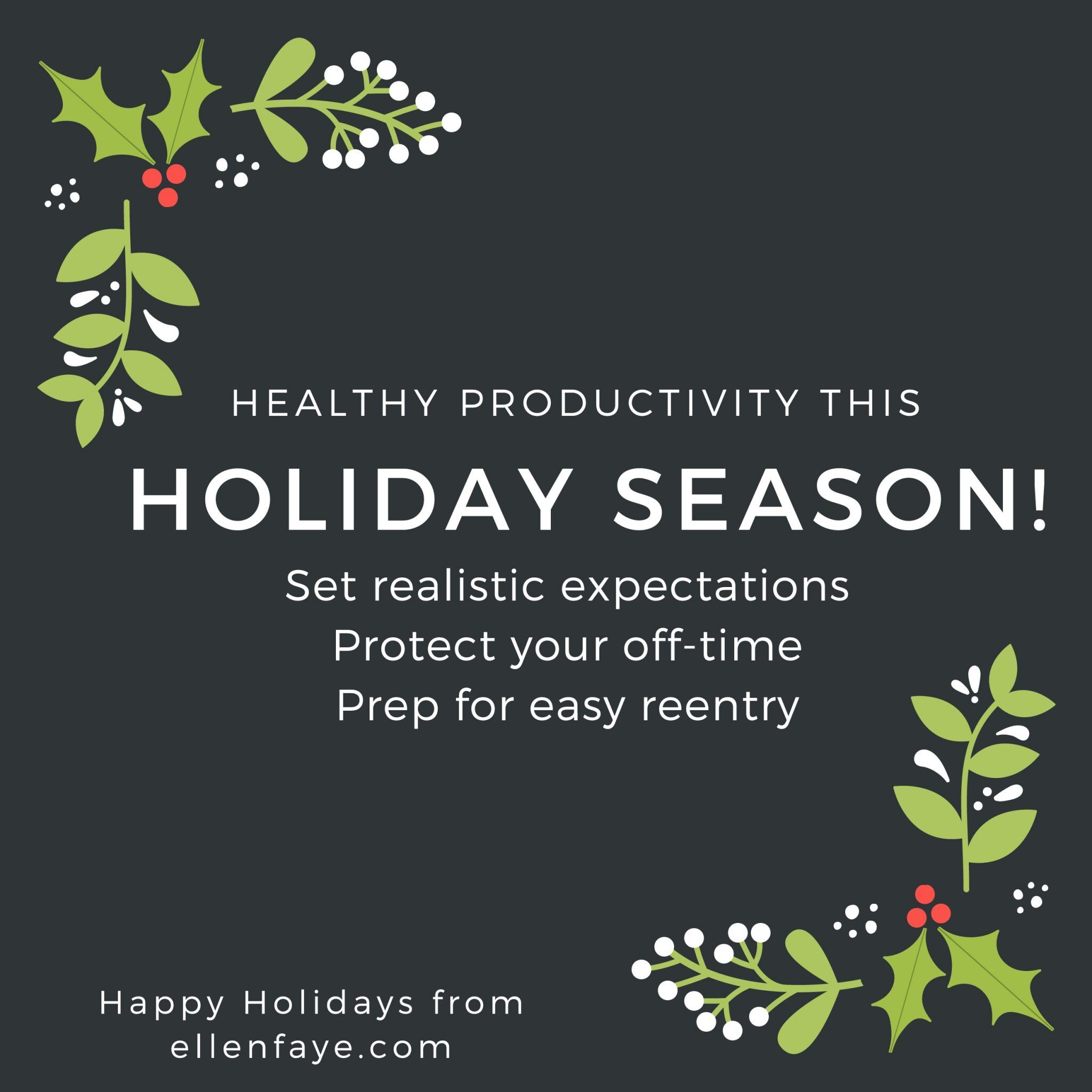
It’s a hard time of year to be productive.  There are so many distractions!  Instead of trying to do it all, how about doing what you have to do well, and setting yourself up to have a truly healthy and happy holiday season.

Be realistic about how much you can get done between Thanksgiving and New Year’s and create a plan to get it done:

  • Use your to do list to support you in identifying the work that has to get done
    • While I’m a HUGE fan or organizing your list in order of priority I know some of you chose other approaches.
    • Simple solution – use your Sharpies for colored stars – red for “must be done before Christmas” and green for “would love to do before Christmas.”
  • Set deadlines on your important work – those red star projects. Then assess
    • Can I get this all done and still do everything else I want to do (parties, shopping, decorating)?
    • If not, reassess and be realistic about what you can really accomplish
  • Choose non-essential work carefully – don’t have unrealistic expectations
    • Ask yourself “what’s the worst thing that would happen if I don’t do this before New Year’s?”

Protect your off-time. When not at work or working:

  • Know that your office won’t fall apart if you don’t check your email
  • If you check your email and there is something you want to do, do it and get it done, but don’t feel like you have to do more than that.
  • Stay present – remove the temptation of distraction
    • When out or doing something fun, use the Do Not Disturb on your phone
    • Keep your phone in your purse or pocket… or gasp (leave it in another room, in the car or somewhere out of reach!)

Prep for an easier reentry:

  • Going out of town or taking a few days off? Prep for leaving.  Coming back to a clean slate, both physically and digitally, will help you get back into action much more quickly. Before you leave, take an extra hour or two to:
    • Clear your desk
      • Throw your trash/recycling away
      • File papers you want to keep for future reference
      • Put your current projects into their own folders and set them in a project file holder
    • Clear your email inbox
      • Delete the trash (yes – get the JUNK out of your inbox!)
      • File emails you want to keep for future reference (Make a 2019 folder and put it all there…)
      • The only thing left in your inbox will be things you need to address when you get back. Now you have a fighting chance!
    • Work harder to finish your “must do before Christmas” so you can take time off and really relax and enjoy yourself.

Wishing you a healthy and productive holiday season.
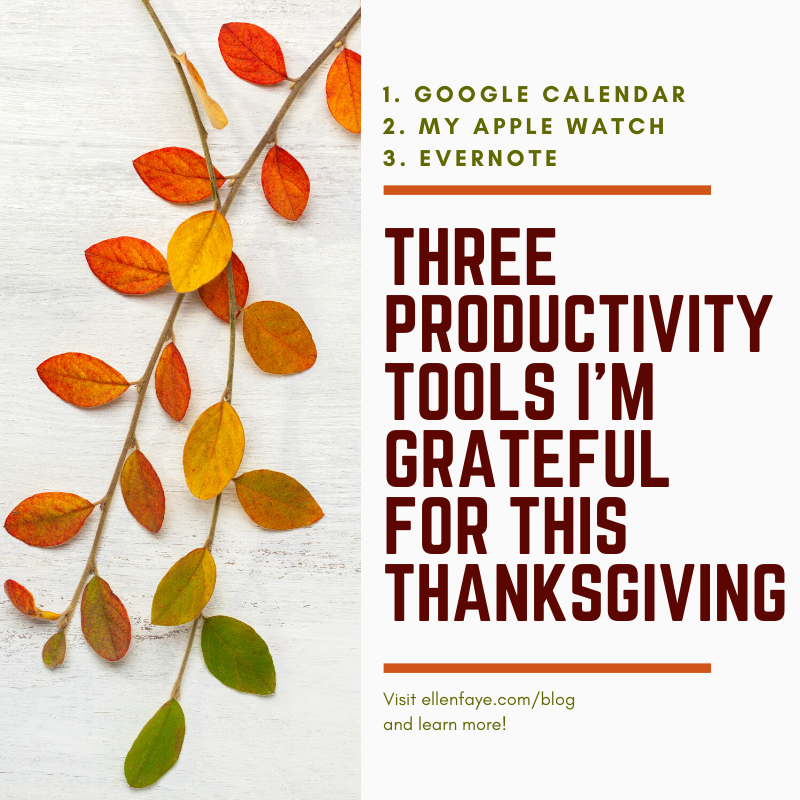
  1. Google Calendar
    • Because it syncs flawlessly with my iPhone.
    • Because of the new REMINDER feature that reminds me of tasks I need to do on a specific day.
    • Because I can paste a phone # or Zoom link into the location field.
  2. Apple Watch
    • Because I can keep my phone on silent and my wrist vibrates when I have a call or text.
    • Because I can quickly find my iPhone at any time by pressing one button (iPhone pings!)
    • Because I now don’t need to have my phone with me all the time.
      • I really value that I can get help or be reached in the case of an emergency.
      • And I love that I don’t have to carry a pocketbook and can pay for things with Apple Pay.
  3.  Evernote
    • Because it’s easy to manage my tasks and change my categories as needed.
    • Because it’s easy to manage a project in a note.
    • Because it’s easy to find the notes I take!

Productivity Tools I WANT for Hanukkah/Christmas – The ability to mark my texts as UNREAD….The ability to mark my texts as UNREAD…The ability to mark my texts as UNREAD…The ability to mark my texts as UNREAD….

Most people rely on their internal compass to get their important tasks done. But what happens when that internal compass doesn’t motivate you ENOUGH for you to get started?

Sometimes deadlines or bosses exert enough external pressure to complete the task, but other times even that isn’t enough. Add to this, that the more time passes, the worse the incomplete tasks make you feel, and the task becomes even more daunting.

How can you get those daunting tasks done? (more…)

use post-its to simplify planning your next project
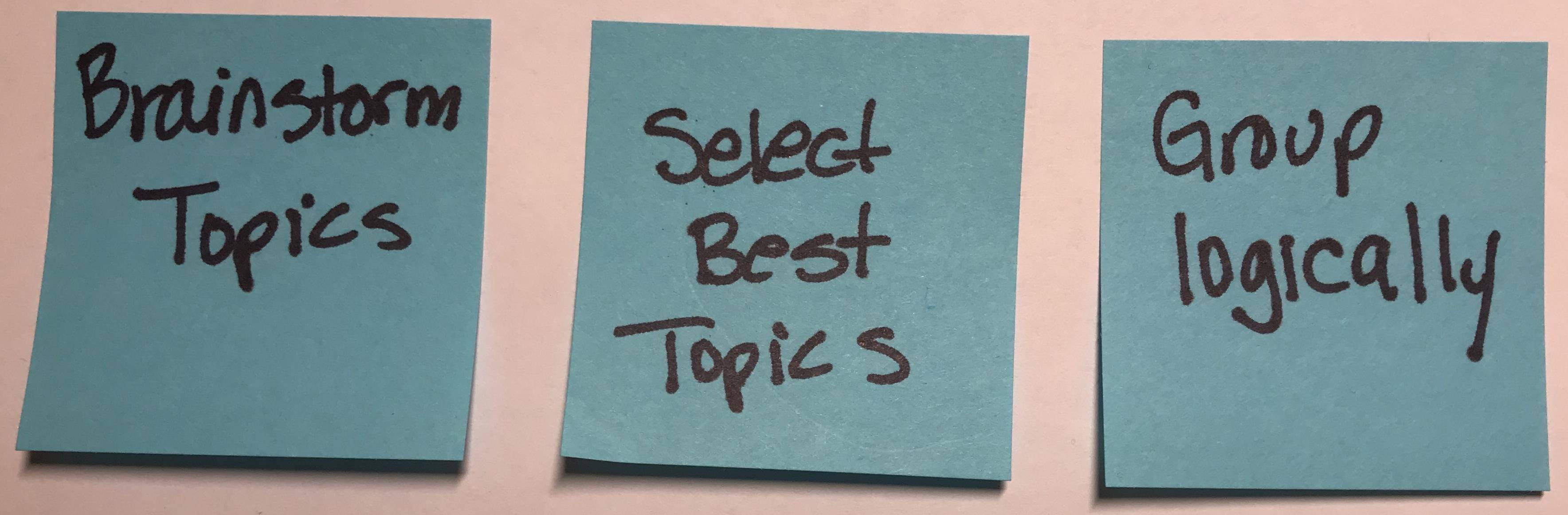
Do you have a project to do, but don’t know where to start?  Most of us don’t have access to complex project management software, nor do we want to make the time investment to learn to use it.  I’ve developed a simple project planning process that yields many of the same results without the learning curve.

1.  Get a stack of Post-its

2.  Write down each task associated with the project. Don’t worry about writing them in any order, just write as fast as the ideas come to you.  Be sure to use a new post it for each individual task.

3.  Put the post-its in order. Consider – what has to come before another step, what would be the most logical way to do the work, if there is any significant wait time, and what would be best for you?  During this process you may think of extra steps.  Create a post-it for those steps and insert them into the process.

4.  Assign a length of time it will take to complete that step to each post-it – it could be 15 minutes, an hour or a week.

(more…)