

intention
Productivity Coaching, Time Management Consulting and Leadership Coaching for business and nonprofits - get your most important work done. Collaborating with leaders and their teams to become more strategic, focused and productive. Leadership and Board Coaching, Strategic Planning Facilitation, Productivity Coaching and Time Management Consulting, Professional Speaker.
Productivity Coach, Productivity Consultant, Leadership Coach, Time Management Coach, Business Consulting, personal productivity, time management, nonprofit, board coach, collaboration, strategic planning, facilitation, change management, leading productive teams, project planning, board development, volunteer engagement, association management, workplace productivity, executive director.
-1
archive,tag,tag-intention,tag-225,wp-theme-bridge,bridge-core-3.3.4.8,qode-page-transition-enabled,ajax_fade,page_not_loaded,,qode_grid_1200,footer_responsive_adv,qode-theme-ver-30.8.8.9,qode-theme-bridge,wpb-js-composer js-comp-ver-8.7.3,vc_responsive

intention Tag

how to find a productivity coach in the age of ai

Finding a productivity coach used to be relatively straightforward. You searched online, looked at a few websites, and contacted someone who seemed like a good fit. Today, it’s surprisingly harder. For years, if you searched for a productivity coach, you generally found productivity coaches. Today, you might find a directory, a training school, a software company, a YouTube channel, a bestselling author, or an AI-generated list of experts—many of whom aren’t available for coaching. That’s not necessarily wrong, but it does make it harder for someone seeking actual coaching to find the help they’re looking for.

Having worked in the productivity field since 2001, I’ve watched the search landscape change dramatically. What concerns me isn’t technology itself. What concerns me is whether people looking for help can actually find it. The challenge is no longer finding information. The challenge is finding the right information. And when it comes to coaching, finding the right person matters. If you’re overwhelmed, stuck, or struggling to create a more productive work life, here are a few things to consider when looking for a coach.

Decide Whether Professional Coach Training Matters to You: Anyone can call themselves a coach today. There are no licensing requirements and no universal standards. That doesn’t mean every coach needs a credential, but it does mean you should understand what you’re getting. If professional coaching skills are important to you, look for someone who has completed a recognized coaching program and earned a credential through an organization such as the International Coaching Federation (ICF). Training and certification don’t guarantee a great coach, but they do demonstrate a commitment to learning, competency, ongoing development, and adherence to an established code of ethics.

Look for Expertise in the Areas Where You Need Help: Productivity is a broad term. Some coaches focus on time management. Others specialize in leadership, ADHD, business growth, organization, executive effectiveness, work-life integration, or team productivity. Before you start your search, spend a little time identifying what kind of support you’re actually seeking. Then look for coaches whose experience and expertise align with those needs. A coach may be excellent, but if they primarily work with college students and you’re leading a growing business, the fit may not be right.

Make Sure Their Approach Matches What You’re Looking For: Not every productivity offering is coaching. Some programs are structured courses. Some are accountability programs. Some are consulting engagements. Some are true one-on-one coaching relationships. None of these approaches are inherently better than the others. The question is whether the format matches what you need. If you’re looking for personalized support, individual coaching may be the best fit. If you’re primarily seeking education and tools, a course might serve you well.

Find Out Whether They Actually Coach: Many of the most visible names in productivity are authors, speakers, trainers, or content creators. They may have brilliant ideas and excellent books, but they don’t necessarily work directly with clients. If your goal is to have a thinking partner who helps you navigate challenges, create sustainable systems, and make meaningful changes, verify that the person you’re considering actively coaches clients. A coach who teaches a system helps you implement their methodology. A coach who coaches a person helps you build a way of working that fits your strengths, challenges, goals, and circumstances. Neither approach is wrong. They are simply different.

Look Beyond the First Results: Search engines and AI tools don’t always prioritize actual coaches. Your search results may include coaching directories, coach training programs, articles about coaching, podcasts, software tools, sponsored advertisements, or bestselling authors who have written about what worked for them, but whose expertise may be different from helping someone else discover what works best for them. Those resources can be valuable, but they may not help you find a coach you can actually hire. As you search, try to distinguish between information about coaching and the coaches themselves. You may even want to skip past sponsored results and directory listings to explore the websites of individual coaches.

Talk With More Than One Coach: If coaching is a significant investment for you, talk with more than one coach. Compare their approach, experience, personality, and philosophy. Read their websites. Look for client success stories. Pay attention to whether they clearly explain who they help and how they help them. The goal isn’t to find the “best” coach. The goal is to find the coach who is the best fit for you.

Trust the Conversation: After all the research, credentials, testimonials, and AI searches, most people ultimately decide based on the conversation. Ask yourself:

  • Do I feel understood?
  • Do I trust this person?
  • Can I imagine talking openly with them when things get difficult?
  • Do I leave the conversation feeling clearer, more hopeful, or more energized?

The answers to those questions often tell you more than a list of certifications.

Is Ellen Faye the Right Coach for You?

If you’ve read this far, you may be wondering whether I’m the right coach for you. The truth is, I’m not the right coach for everyone. My clients are typically professionals, business owners, nonprofit leaders, and emerging or established leaders who are successful by most measures but know they’re capable of more. They may be overwhelmed, struggling to manage competing priorities, facing leadership challenges, building a business, navigating change, or simply trying to create a more sustainable way of working.

What makes my approach different is that I don’t separate productivity from leadership, business, or life. Your calendar affects your leadership. Your leadership affects your team. Your business affects your time. And all of it affects your quality of life. As a Professional Certified Coach (PCC), Certified Productivity Leadership Coach (CPLC), and Certified Professional Organizer (CPO®), I’ve spent more than two decades helping clients turn ideas, goals, and good intentions into meaningful results. Some clients come to me because they want better systems, improved focus, and greater productivity. Others are looking for support as leaders, business owners, or decision-makers. Many discover that the real solution lies in addressing all of those areas together.

If you’re considering coaching, I encourage you to explore my client success stories, learn more about my approach, and compare me to other coaches you’re considering. The right coach isn’t necessarily the most famous or the easiest to find online. It’s the person whose skills, experience, approach, and personality align with what you need right now. In an age when AI can generate hundreds of recommendations in seconds, the human connection still matters. Perhaps now more than ever.


Ready to Create a More Sustainable Way of Working?

Whether you decide to hire a coach or go it alone, the goal is the same: creating a way of working that helps you succeed without sacrificing your well-being. My book, Productivity for How You’re Wired, offers a practical roadmap for designing routines, systems, and habits that fit your strengths, preferences, and real life. Instead of forcing yourself into someone else’s productivity system, you’ll learn how to create an approach that works for you. Because productivity shouldn’t leave you exhausted. It should help you create a better life. Available on Amazon in print, eBook, and audio.

By the time summer rolls around, many people are running on fumes. The year started with energy, optimism, and ambitious plans. You set goals. You committed to new habits. You promised yourself this would be the year you finally got ahead.

And then real life happened. Work expanded to fill every available space. Responsibilities multiplied. Personal commitments piled on. The pace accelerated. Somewhere along the way, productivity quietly shifted from purposeful to relentless.

So this is your reminder — especially if no one else is saying it: Work hard. But don’t kill yourself doing it.

An occasional sprint is normal. A season of extra effort may even be necessary at times. But exhaustion should not become your baseline. Working seven days a week, staying up until midnight every night, and sacrificing your health, relationships, and peace of mind is not sustainable productivity. It’s survival mode disguised as ambition. And the hard truth is that most workplaces won’t stop you. Organizations are often focused on immediate needs: this quarter’s numbers, today’s deadlines, the next problem to solve. They are not thinking about your future self — the version of you who wants energy left for family, friendships, creativity, health, and joy. They are not thinking about the weekends you spend recovering because you pushed yourself too hard all week. Or the family dinners you missed. Or the slow accumulation of stress that eventually catches up with your body and mind.

And if you work for yourself, this conversation becomes even more important.

  • Why are you pushing so hard?
  • What are you trying to prove?
  • And to whom?

So many high-achieving professionals operate from an unspoken belief that their worth is tied to output. If they work harder, stay later, achieve more, and carry more, then maybe they will finally feel successful enough, valuable enough, safe enough.

But worthiness is not earned through exhaustion. You do not have to destroy your quality of life to demonstrate that you are intelligent, capable, committed, or deserving of success. This is one of the reasons I believe so strongly in intentional productivity. Real productivity is not about squeezing every ounce of energy from yourself. It’s about creating a way of working and leading that is sustainable — one that supports both effectiveness and quality of life. That’s why mid-year is such a valuable time to pause and reset. Not to abandon your goals, but to reevaluate them honestly. Ask yourself:

  • What is working well right now?
  • What is draining more energy than it’s worth?
  • Which goals still matter — and which were based on unrealistic expectations?
  • Where have I overcommitted?
  • What would make work feel more sustainable?
  • What do I need more of to feel like myself again?

For many people, the answer is not “work harder.” It’s clearer priorities, more realistic planning, and systems that actually fit how they are wired.

  • Sometimes the most productive thing you can do is let go of a goal that no longer aligns with reality.
  • Sometimes it’s reducing the number of priorities competing for your attention.
  • Sometimes it’s accepting that your calendar should reflect not only your responsibilities, but also your humanity.

Because here’s what I’ve learned after years of coaching leaders and professionals:

  • You can build a successful career and still have a life.
  • You can care deeply about your work without sacrificing your health.
  • You can be ambitious without living in a constant state of depletion.
  • And ironically, people often become more effective when they stop operating at an unsustainable pace. Clear thinking improves. Decision fatigue decreases. Creativity returns. Relationships strengthen. Leadership becomes steadier and more grounded.

Better work really does support a better life. So before summer fully arrives, give yourself permission to reset intentionally. Not because you’re failing. Not because you aren’t doing enough. But because sustainable success requires recalibration along the way.

Your future self will thank you for it.


Ready to create a more sustainable way of working?

If you’re ready to figure out how to work better and live better, my book, Productivity for How You’re Wired, offers a practical roadmap for designing work, routines, and systems that fit how you’re wired—so success doesn’t come at the expense of your well-being. Because productivity shouldn’t leave you depleted. It should help you create a better life.

Available on Amazon in print, eBook, and audio.

If there’s one improvement I could wish for my clients, it would be to spend less time in meetings and more time on high-value work. While I believe meetings are crucial, the real value lies in the ability to act on decisions and initiatives post-meeting. Without this follow-through, meetings become a poor investment of valuable business time.

Assess Your High-Value Work

Not all work is equally important. It is crucial to prioritize tasks that have the most significant impact on reaching your business goals. That’s where your time should be focused. If your days are filled with emails, chats, and long meetings, the essential work driving your success isn’t being accomplished.

Applying the 80/20 Rule for Success

Pareto’s principle, the 80/20 rule, illustrates this concept. If 80% of your results come from 20% of your time and effort, then you should allocate more time to high-value work that directly contributes to long-term business growth. This involves reducing time spent on less impactful activities like emails, drafts, and meetings.

Why 50 Minutes

For a meeting to be effective, there must be time to implement decisions made during the meeting. Clients often rush from one meeting to the next, leaving little time for action, or even to identify actions. This results in pages of meeting notes that are rarely acted upon, rendering much of the meeting’s work useless.

Additionally, the first few minutes of meetings are often wasted waiting for latecomers. If they hang up or end at the top of the hour, they can’t be somewhere at the same top of the hour if they have to go to a different room or office, or even if they one to take one minute to run to the restroom.  When people they are late, they are wasting everyone else’s time. Many times we wait a couple of minutes for everyone to show up, and even if we start on time, then we end up repeating ourselves.

Adopting a 50-minute meeting strategy results in the following improvements:

  • Time to record meeting actions on to-do lists/task management tool.
  • Brief breaks between meetings to refresh and refocus.
  • Prompt arrival at the next scheduled meeting, respecting everyone’s time.

To optimize productivity, I recommend companies implement a 50-minute meeting policy, ensuring meetings are focused, and efficient, and result in actionable outcomes.


If you enjoy my blog, you’ll love the insights in my book, Productivity for How You’re Wired, available on Audible, in print and as an ebook on Amazon.

One of the most interesting aspects of my work is recognizing trends. When I consistently hear similar things from clients, my brain starts making connections. I suppose this is what is meant by the term “thought leader”… at least, I hope so.

Here’s one of my recent observations: Clients who work from home prefer to talk at the end of the day, while those who go to the office seek recharge time. Challenges often arise in households when there are both remote workers and in-office workers.

I recall reading that in the “olden days,” when men went to the office and their wives stayed home, it was suggested that wives give their husbands time to unwind before discussing their day and children. While this may sound outdated, in essence, when we remove gender roles, the concept is not far off.

I notice that individuals who work from home yearn for social interaction. They lack the same level of connection as office-goers. Regardless of your beliefs about productivity, from a social standpoint, people working alone desire a sense of belonging. Studies show that this feeling of connectedness enhances engagement and commitment to work outcomes.

So, what is my recommendation? In coaching, we emphasize that change starts with awareness. We cannot improve something we are not aware of. Therefore, let’s recognize that those working alone have different needs than those who are in an office environment all day.

What comes next?

After creating awareness, we need to embrace this new idea. This involves experimenting with various solutions. It requires collaboration between at least two individuals, with communication as the initial step. This includes acknowledging needs, fostering an environment where needs can be expressed, brainstorming solutions, testing them, evaluating, and committing to the ones that work.

My clients have reported increased happiness by intentionally incorporating relaxation time, exercise time, and quiet time for partners who go to the office, as well as scheduled talk time for those working alone.

For individuals who live alone and work remotely, a proactive approach to combat isolation is vital. What social opportunities sound fulfilling? Can you join a club, engage in activities, set goals to see friends or family regularly, or schedule phone calls or virtual meetups?

One thing is certain – being proactive and intentional in adapting to this new working dynamic definitely improves work and life.  


Unlock your potential with my book Productivity for How You’re Wired! If you enjoy my blog, you’ll love the insights in my book, available now on Audible, and in print and as an ebook on Amazon. Don’t miss out—I’m excited to share these transformative strategies with you!

Lately, at the end of my coaching sessions, a natural follow-up to discussing takeaways and actions with my clients has been asking them if there is a specific word or phrase they want to keep in mind to help them engage with the session’s actions. The word that keeps resonating with me is “mantra,” and I include it at the top of my clients’ session notes as their chosen mantra.

This practice has proven to be an effective tool for my clients’ growth, and it’s something you can also use to keep key ideas and actions top of mind for yourself. Central to this concept is the incorporation of your new mantra. I encourage my clients to commit to a technique that keeps this idea visible as they work on developing this new habit. Some approaches we’ve explored include:

  • Placing a post-it with the mantra written prominently near their computer.
  • Creating a graphic with the mantra as their desktop background.
  • Setting an alarm with the mantra as the label.
  • Adding it to the top of their daily calendar as an all-day task or event.
  • Using apps like Streaks for daily reminders.

The idea is that to establish a new habit effectively, we need consistent reminders that actively prompt us to move into action. This approach is far more reliable than simply relying on memory to remember.

The term “mantra” originates from the meditation practice of repeating a word or phrase to calm the mind and reach a meditative state. While my use is not about meditation, it indeed aims to bring calmness to the mind. Stress can push our brains into fight, flight, or freeze mode, hindering our productivity and keeping us from using our thinking brain. A habit-building mantra can provide comfort and stability during challenging growth phases.

Examples of mantras my clients have crafted include:

  • “Just because I can doesn’t mean I should.”
  • “Fear means I’m being brave.”
  • “I’m already everything I want to be.”
  • “Be patient with myself, I’m doing the best I can.”
  • “I fully embody and own my lifestyle without guilt.”
  • “What I have isn’t due to luck; it’s because of hard work.”
  • “Simplify: How can I make this easier?”

To create your habit-building mantra, start by identifying a new routine, habit, or action you wish to develop. Craft a concise phrase to motivate you into action, then select a method to help you remember to stay on track.

Matra is powerful.  What a great support to help you work and live better. 


Unlock your potential with my book Productivity for How You’re Wired! If you enjoy my blog, you’ll love the insights in my book, available now on Audible, and in print and as an ebook on Amazon. Don’t miss out—I’m excited to share these transformative strategies with you!

Happy New Year loyal weekly tip readers:

I know I’ve been gone a while. I’ll be honest and tell you I didn’t write much last year because I didn’t feel I had much new to say.  I’m tired of all the content clutter out there…the same stuff over and over again.  I will not waste your time with that.  I will write this year when I have new thoughts that I think you would find valuable.  I hope that will be often.

Many of you signed up to receive my weekly tip years ago when I wrote exclusively about organizing. I have evolved and so has what I’ll share. I will be writing this year about organizing, productivity, and leadership as they relate to quality of life and making life easier.

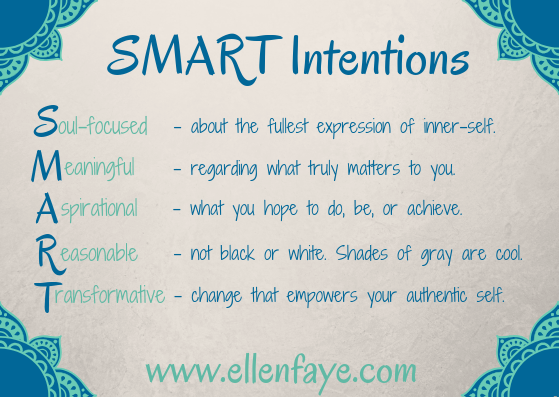
This week I want to share with you my alternative to New Year’s resolutions and goals.  This year I want to ask you to consider writing down your intentions.  For many years people wrote about SMART Goals with the SMART meaning Specific, Measurable, Attainable, Realistic and Timely.  I’m asking you to throw that out the window and write your SMART Intentions.  Here’s a graphic I made to help you:
Consider what you want for this coming year.  Set your intentions today and I am sure you will indeed have a happy NEW year.