
simple
Productivity Coaching, Time Management Consulting and Leadership Coaching for business and nonprofits - get your most important work done. Collaborating with leaders and their teams to become more strategic, focused and productive. Leadership and Board Coaching, Strategic Planning Facilitation, Productivity Coaching and Time Management Consulting, Professional Speaker.
Productivity Coach, Productivity Consultant, Leadership Coach, Time Management Coach, Business Consulting, personal productivity, time management, nonprofit, board coach, collaboration, strategic planning, facilitation, change management, leading productive teams, project planning, board development, volunteer engagement, association management, workplace productivity, executive director.
-1
archive,tag,tag-simple,tag-24,wp-theme-bridge,bridge-core-3.3.4.6,qode-page-transition-enabled,ajax_fade,page_not_loaded,,qode_grid_1200,footer_responsive_adv,qode-theme-ver-30.8.8.6,qode-theme-bridge,wpb-js-composer js-comp-ver-8.7.2,vc_responsive

simple Tag

It’s August. It’s hot. Everyone’s either on vacation or thinking about it. You might be wishing you had more time to rest, slow down, and escape the heat—but somehow, the work still needs to get done.

That’s why how you spend your work time really matters. You don’t need more hours—you need more impact from the hours you already have.

Here’s something I often share: “One unit of focused time is equal to four units of broken focus.” — American Academy of Family Physicians

In other words, ten focused minutes can be as productive as forty minutes of distracted, fragmented effort. The math is simple—and persuasive. Especially in a season when we’re all craving more time off the clock.

Start with Clarity: What Matters Most?

Before we dive into distractions, let’s talk about focus. You can’t focus effectively if you don’t know what you’re focusing on. Each morning, take a moment to clarify your most important priorities for the day. I like to jot mine down on a simple sticky note—just a few key tasks that, if completed, will let me feel good about calling it a day.

This doesn’t mean creating a massive to-do list. In fact, it means the opposite.

As Lin Yutang wisely said: “Besides the noble art of getting things done, there is the noble art of leaving things undone. The wisdom of life consists in the elimination of nonessentials.”

Letting go of the nonessentials is an act of leadership. You protect your time by honoring what matters most—and letting the rest wait.

Eliminate Distractions: Your Phone Isn’t Helping

One of the biggest threats to focused work? The small device that’s always within reach. Our phones—helpful, powerful, and endlessly distracting—can derail even the best-laid plans for a focused work session.

Want to tap into the power of those “ten focused minutes”? Start by putting your phone in another room. Seriously. Airplane mode is great. Do Not Disturb works too. But if it’s physically out of sight, you’re less likely to reach for it out of habit.

Consider turning off all but the most essential notifications. For me, that’s calls and text messages—nothing else. During focused work sessions, even a single ping can break your concentration and cost you more than just a few seconds. Research suggests it can take 20+ minutes to fully recover from an interruption. Multiply that over a few distractions, and you’ve just lost your entire work block.

Plan for the Ramp-Up: Flow Takes Time

Here’s something we don’t talk about enough: it takes time to settle in and focus. So don’t expect to sit down and immediately start cranking out brilliant work. That’s not how human brains operate.

Instead, plan for ramp-up time before you dive into focused work. Do a quick check of your email or messages, respond to anything urgent, and then intentionally clear the decks. Grab water. Take a bio break. Cue up music that helps you concentrate. Close the extra browser tabs. Then give yourself permission to go deep.

This preparation isn’t procrastination—it’s setting the stage for high-quality work. It’s part of what turns ten minutes into something powerful.

Work Smarter, Rest Better

In this summer heat, when our energy can feel low and our motivation stretched thin, we don’t need more hours—we need more impact from the hours we do have. That starts with focus, clarity, and protecting our attention like the limited resource it is.

So before you burn out trying to push through an endless list, stop.

  • Write down your essentials.
  • Silence the noise.
  • Create the conditions for deep work.
  • And remember: ten focused minutes might be all you need to make real progress today.

Want more practical strategies like this? Chapter 11: Time Matters in my book Productivity for How You’re Wired dives deeper into how to plan your day, manage your time, and get the right things done without the overwhelm. It’s available now on Amazon—in print, eBook, and audio.

Feeling overwhelmed by too much to do and not enough time to do it? You’re not alone—and you don’t have to stay stuck in that cycle. Through one-on-one coaching, I help professionals and leaders like you cut through the noise, ditch the never-ending to-do lists, and align your productivity with how you’re wired—so you can finally create systems that actually stick.


Ever stand in front of the fridge wondering what to make for dinner, only to give up and snack on crackers? Or scroll Netflix for so long you run out of time to actually watch something? It’s frustrating—and oddly common.

Here’s why: it’s not that you’re indecisive or lazy. It’s decision fatigue, and it’s draining your brainpower, making even the smallest choices feel surprisingly difficult.

One of my high-performing clients—smart, successful, and productive—once told me that the thing he and his partner argued about most wasn’t money or chores. It was what to order in for dinner.

At the end of the day, they were both exhausted. They’d scroll through endless restaurant options, debate what sounded good, get frustrated, and end up ordering late—or worse, not eating at all. That small daily choice became a major source of friction.

I suggested they make a simple list: five favorite takeout places and their top two orders from each. The result? Instant relief. They ordered faster, ate earlier, weren’t hangry, and most importantly, enjoyed their evenings together instead of wasting time figuring out what to eat. One little system turned a daily pain point into something easy—and even enjoyable.

That’s the magic of simplifying small decisions.

Decision Fatigue Is Real

Some studies estimate we make over 35,000 decisions a day—most of them small and forgettable. What to wear. What to eat. What to tackle first. Each one chips away at your mental energy.

And when your brain is tired, even “easy” decisions feel hard. You overthink. You second-guess. You procrastinate. Or you avoid the choice altogether and just do nothing (hello, standing in front of the fridge again).

The problem? All of that mental clutter spills into your personal time. You end up feeling frazzled, behind, and drained—even when nothing major went wrong.

Make the Easy Decisions Easy

You don’t have to overhaul your life. Just start by creating defaults—shortlists of pre-approved, go-to options that remove friction from your day.

Here are four areas where this can make a big difference:

1. What to Make for Dinner

Instead of reinventing the wheel every night, build your own personal menu of favorite meals. Keep your two go-to recipes from key categories—like poultry, seafood, vegetarian, meat, entrée salads, and hearty soups—in a folder, binder, or electronic file. That way, when it’s time to plan dinner, you can flip through your curated favorites and quickly pick something you’ll actually enjoy cooking and eating.

You don’t need a hundred recipes—just a dozen or so that you know and love. This makes meal planning easier and helps you avoid that overwhelmed, “I don’t know what I feel like” feeling at the end of a long day.

2.  Ordering In

Like my client, make a list of your favorite delivery spots and go-to orders. Save them in your food delivery app, jot them in your notes, or put them on the fridge. When you’re tired and hungry, this saves time, energy, and potential tension.

 3. What to Watch

Keep a “watch next” list in your streaming app or phone. When you finally sit down to relax, you don’t want to waste half the evening browsing. Make the decision once, and keep a short list ready to go.

 4. What to Read

Create a running to-read list so that when you finish one book, the next one is already lined up. You’ll read more, feel less decision fatigue, and avoid the rabbit hole of reviews and recommendations when you just want to enjoy a story.

 This Isn’t About Being Rigid

You can still try new restaurants, cook new meals, and discover new shows. But when you’re tired or low on brainpower, your defaults have your back. Think of these lists as your brain’s personal assistant—quietly saving you from unnecessary stress. Let’s keep the easy decisions easy… and free up your energy for what matters most.


Ready to Simplify More? If you’re feeling stuck in the weeds of daily decision-making, I can help. Through one-on-one coaching, I work with professionals and leaders like you to cut through the clutter, align your productivity with how you’re wired, and create systems that actually stick. Want more strategies like this? My book,  Productivity for How You’re Wired, is packed with real-life tools and ideas—and it’s available now on Amazon.

use post-its to simplify planning your next project
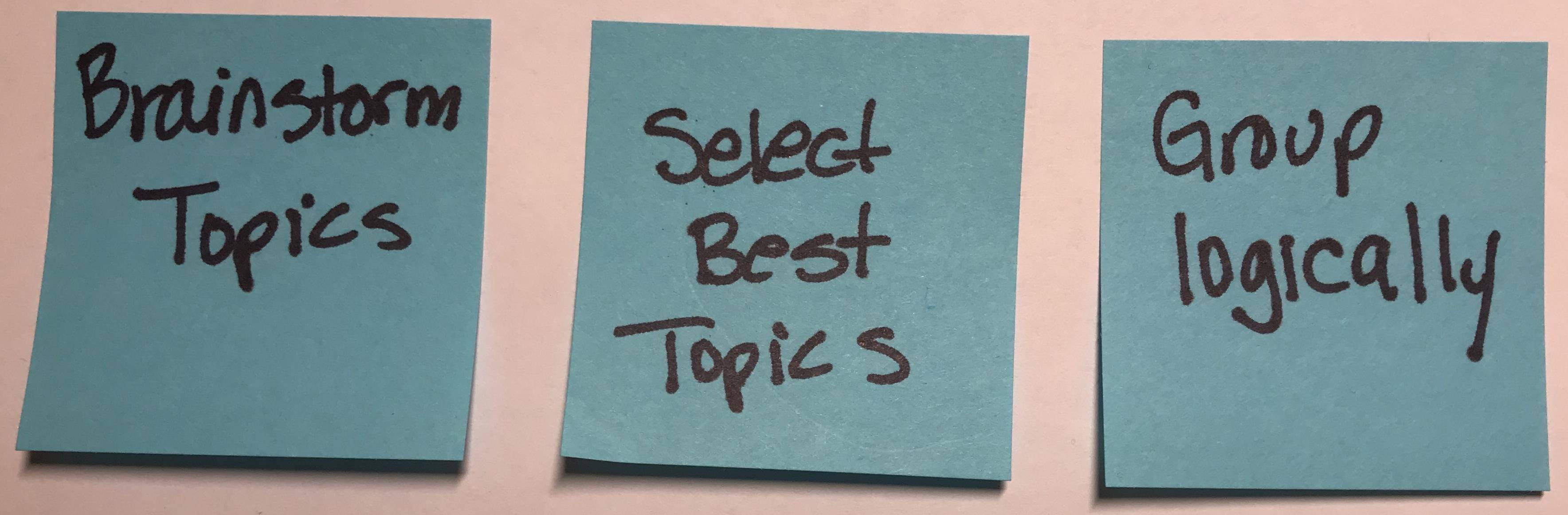
Do you have a project to do, but don’t know where to start?  Most of us don’t have access to complex project management software, nor do we want to make the time investment to learn to use it.  I’ve developed a simple project planning process that yields many of the same results without the learning curve.

1.  Get a stack of Post-its

2.  Write down each task associated with the project. Don’t worry about writing them in any order, just write as fast as the ideas come to you.  Be sure to use a new post it for each individual task.

3.  Put the post-its in order. Consider – what has to come before another step, what would be the most logical way to do the work, if there is any significant wait time, and what would be best for you?  During this process you may think of extra steps.  Create a post-it for those steps and insert them into the process.

4.  Assign a length of time it will take to complete that step to each post-it – it could be 15 minutes, an hour or a week.

(more…)

Most days we have too much to do, too much on our plate so to speak.  If we continually fill our lives with things to please others or only do those things we think we should do, our lives become unfulfilling and mundane.

Think of life like a Thanksgiving plate.  I’m confident that on Thursday you’ll be selective about what you put on your plate so that you’ll have room for all your favorite things.  If you fill up on rutabagas and parsnips just how much room will you have for sweet potatoes and pie?

Live your life like you fill your Thanksgiving plate – be selective about how you spend your time – and you’ll be more satisfied and fulfilled.


search bar

Sometimes just the smallest thing makes a difference.  We spend a lot of time on computers and if we could do what we needed to do faster than there would be more time to do the things we want to do.  Here are my Top Ten Google Search Tricks that help me save time.

Tip Issue Type in Results
1. Spell Don’t know how to spell a word? Type in the word spell and your closest guess. As long as your guess is reasonably close, Google returns the correct spelling Spell infintesimal Infinitesimal
2. Google Images When looking for a product, type in product description and select “images” for your search tool (grey options across the top – 3rd one) Desk top file and select “search images” Pages of desk top files pictures that you can shop from
 3. Define Need a definition?  You don’t need to go to a dictionary website.  Type in “define” and the word. Define Complementary Full dictionary definition
4. Minus Sign If you want to find something but leave out certain results use the minus sign Caterpillar – tractor Insect options not machinery company options
5. Date Range To identify a range of years use two periods. I use it often to get the most current technology results iPhone updates 2018..2019 Only listings posted during that range of dates
 6. Timer Let your computer alert you after a certain amount of time?  Type in “timer” and the length of time. Timer 10 minutes A countdown timer that dings when you are out of time
7. Math Don’t have a calculator handy?  Google does equations. Type in the equation and you’ll get the answer 365 * 24 8760
8. Weather What’s the temperature outside weather and zip code 10 day forecast
9. Answers questions Google is just like your smart phone’s assistant (Siri) When is daylight savings 2014 Starts March 9, Ends Nov 2
10. Exact Words When searching for exact words use quotes to delineate the exact words you are looking for  “Michael C. Jones” Only searches that have the words Michael C. Jones, in that order.


The goal of getting organized and improving productivity is not to be perfect.  It is to make life easier and more enjoyable and fulfilling.  Complex systems are rarely the answer.  The best solutions are often the simplest.  Over complicated systems most often cannot be maintained.  More often than not, well done is good enough.

There are times that being “perfect” is important; in a client proposal, or on a resume, or in a white paper for your boss.  But equally, there are times that you don’t have to be so perfect – I’m not talking about spelling errors, or typos – I’m talking about thoroughness and precision.
When you strive for perfection your time investment is maxed out.  Where can you step back and save a bit of time and energy?  Here are my favorites:

  • Email – ask yourself, do I have to include that piece of information.  The briefer and more to the point your email is the faster it takes to write it and the easier it will be for the person receiving it to send you a prompt response
  • Planning your day – write out the top 5 things (or 3, or 7) you wish to accomplish.  Prioritize them by writing numbers next to each task – 1 for the most important, etc.  Just do it – but don’t spend a lot of time on this task – it will change anyway because you’ll never be able to anticipate the nuances of each day.  It’s the act of  planning that keeps you focused, not the exact plan itself
  • Drop the Penny – round up, it always balances out and it saves such silliness.  Imagine how many payroll dollars would be saved if employees didn’t have to count pennies.  Their impact is insignificant (unless of course you have a million of them – but that’s not the point!)

If you’re a perfectionist, try an experiment.  Pick one thing today and try to be a little less perfect.